
Tungsten Carbide: The Hardest Metal in Men’s Jewellery
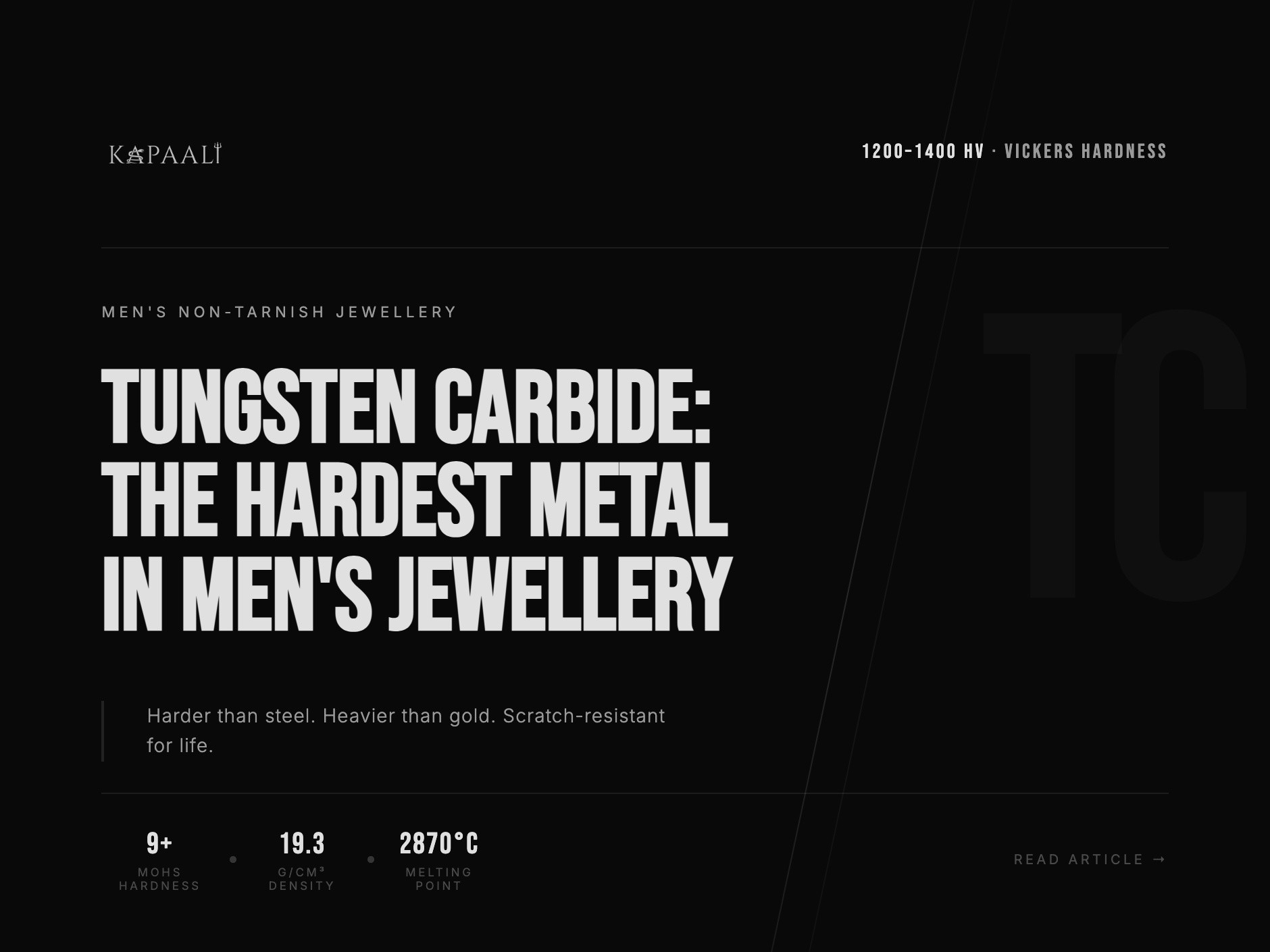
Tungsten carbide sits just below diamond on the hardness scale. Here’s what that means for a ring you wear every day.
There’s a simple test for how good a material is for a ring. Put it on. Live in it for a year. Does it still look like the day you bought it?
For stainless steel, the answer is usually yes. For tungsten carbide, the answer is absolutely yes.
What is tungsten carbide?
Tungsten carbide isn’t mined as a pure material — it’s engineered. Tungsten powder and carbon are combined under extreme pressure and heat (around 1400°C), then sintered into a dense, ultra-hard compound. The result is a material that’s roughly twice as dense as steel and sits at about 9–9.5 on the Mohs hardness scale.
For context: a steel ring sits around 5.5. Glass is around 5.5. Tungsten carbide is almost as hard as diamond, which is 10.
What that hardness means in practice
A steel ring, worn daily, will pick up fine scratches over months. Those scratches catch light at different angles and dull the original polish. It’s normal — even premium metals do it.
A tungsten carbide ring doesn’t scratch from daily wear. The everyday knocks — edges of desks, gym equipment, keys — don’t leave a mark. The polish you see on a tungsten ring on day one is the same polish you’ll see five years from now.
The weight
Tungsten carbide is dense. A tungsten ring of the same size as a steel ring will be noticeably heavier. Some men love that — it has a substantial, premium feel. It’s the difference between a good watch and a cheap one, just from the weight on your wrist.
If you’ve never worn a tungsten ring, the first time you pick one up is a small surprise. It’s immediately obvious it’s not a regular piece of jewellery.
How it’s made — why it costs more
Tungsten carbide can’t be cast or bent like gold or silver. It’s compressed from powder into a rough shape, sintered at extreme temperatures, then precision-machined and polished — often with diamond tools. Any pattern or finish cut into the surface requires specialised equipment.
That’s why tungsten carbide rings are priced above stainless steel. The material and the process are both more demanding.
The one trade-off
Tungsten carbide’s hardness is also its one limitation: it cannot be resized. Because it cannot be bent or stretched, a ring that no longer fits needs to be replaced, not adjusted. If you’re buying a tungsten ring, sizing accurately matters.
For this reason, we strongly recommend using our [ring size guide] before ordering from the Urban Karat line.
Who it’s for
Tungsten carbide is for the man who wants zero maintenance, maximum durability, and a finish that lasts. The kind of person who buys something once and expects it to perform indefinitely.
If you work with your hands, train hard, or just refuse to treat jewellery like something fragile — tungsten carbide is your material.
Check out our tungsten carbide rings here.